Enterprise Value vs Equity Value: The Difference That Decides What You Actually Get Paid
By Bill Anderson, FCCA, Chief Executive Officer, Assetica · Published 2026-07-29

Direct Answer: Enterprise value is the value of a business’s operations: what it would cost to buy the whole company debt-free and cash-free. Equity value is what the shareholders actually receive. That is enterprise value minus net debt, minus minority interests and preferred claims, plus any surplus assets. A deal is almost always negotiated and reported at the enterprise value headline. But the cheque a seller receives is the equity value. On a typical AED 10 million enterprise value deal with AED 2 million of net debt, the seller nets AED 8 million, not AED 10 million. You need to understand the bridge between the two numbers, and which one a given multiple actually prices, before you agree a price, read a term sheet, or compare your business to a competitor’s sale.
Every business owner eventually hears two numbers that sound interchangeable and are not. A buyer says the business is worth AED 12 million. A banker says the same business trades at 6x EBITDA. An investor's term sheet references a pre-money valuation. Are these the same figure? Usually not. The gap between them is exactly the debt on the balance sheet, the cash sitting in the account, and whoever else has a claim on the company before the shareholders do. Get this wrong and you will negotiate the wrong number, misread a comparable transaction, or be genuinely shocked at what actually arrives in your bank account on completion day.
What Is Enterprise Value?
Enterprise value (EV) is the value of the operating business itself, independent of how it happens to be financed. It answers one question. What would it cost to acquire the whole company, take on its debt and strip out its surplus cash, so you own only the trading operation? Because it excludes the effect of the capital structure, enterprise value lets you compare two businesses fairly. That holds even if one is funded mostly by debt and the other by equity, or if one holds AED 3 million of cash on its balance sheet and the other holds none.
This is also the figure that valuation multiples like EV/EBITDA and EV/Revenue are built to price. It is almost always the number that appears first in a Letter of Intent, a term sheet or a press release announcing a deal. That is because it represents the size of the transaction from the buyer’s perspective: everything they are taking on, operations and obligations together.
What Is Equity Value?
Equity value, sometimes called shareholder value, is what is left for the owners once every other claim on the business has been settled. Imagine you sold the whole company today, paid off every lender, satisfied every preferred shareholder and minority interest, and kept whatever cash was left over. The amount remaining for the ordinary shareholders is the equity value. For a listed company, this is simply market capitalisation: share price multiplied by shares outstanding. For a private UAE or UK SME, it is the figure your independent valuation report ultimately certifies. That is the number the Golden Visa threshold, a shareholder buyout or an inheritance tax return is actually measuring.
The critical point: equity value is what the shareholder actually receives. Equity value is the number that matters to you personally, not the enterprise value headline a broker quotes. That applies whether you are negotiating a sale, applying for a Golden Visa where the AED 2 million threshold is assessed against your specific shareholding, or working out what a departing partner is owed.
The Formula: How to Bridge Between Them
The standard bridge runs one way from enterprise value down to equity value, and the reverse way back up. Every item in the bridge is one of two things. Either a claim that sits ahead of the ordinary shareholder, which you subtract. Or a surplus asset not needed to run the business, which you add back.
| Start with Enterprise Value | Adjustment | Why |
|---|---|---|
| Total debt and debt-like items | Subtract | Lenders and lease liabilities are paid before shareholders see a cent |
| Cash and cash equivalents | Add back | Surplus cash belongs to the shareholders, not the operating business |
| Minority (non-controlling) interests | Subtract | Value attributable to other shareholders in a consolidated subsidiary |
| Preferred shares | Subtract | Preferred holders rank ahead of ordinary equity |
| = Equity Value | What the ordinary shareholders actually receive |
In shorthand: Equity Value = Enterprise Value − Net Debt − Minority Interests − Preferred Equity, where net debt is total debt minus cash and cash equivalents. Run the formula the other way, starting from a listed company’s market capitalisation, and you add back net debt, minority interests and preferred equity to arrive at enterprise value. Either direction, the logic is the same: enterprise value belongs to everyone with a claim on the business; equity value belongs only to the ordinary shareholders.
A Worked Example
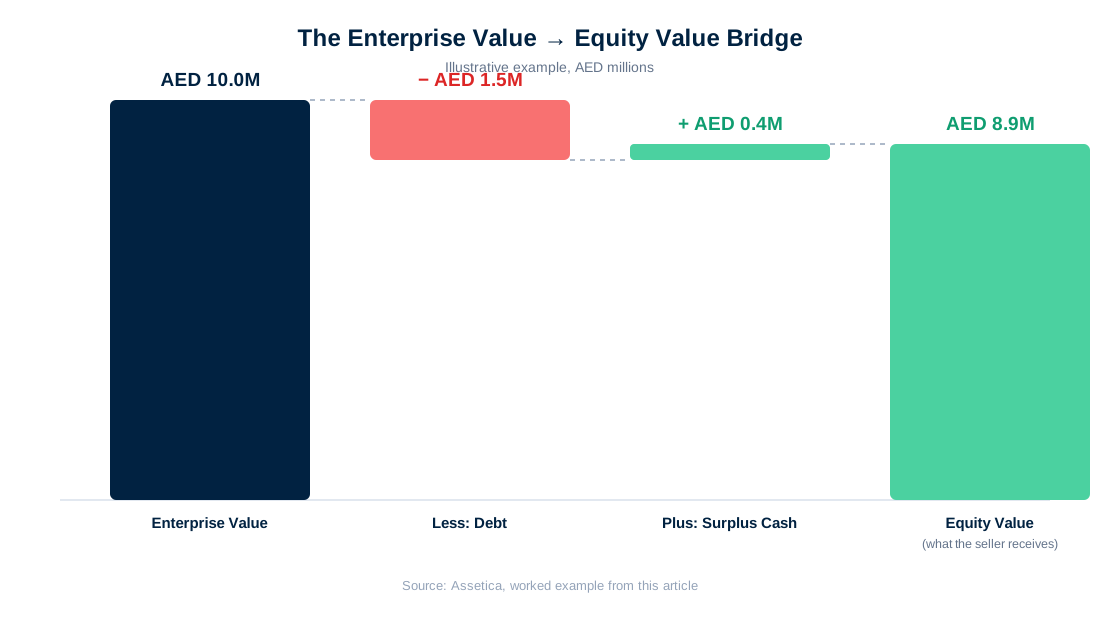
Take a Dubai trading company with normalised EBITDA of AED 2 million. Comparable transactions in its sector support a multiple of 5x EBITDA. The business carries AED 1.5 million of bank debt and holds AED 400,000 of cash that is genuinely surplus to working capital needs. There is one shareholder, no minority interest and no preferred stock.
| Step | Calculation | Result |
|---|---|---|
| Normalised EBITDA | — | AED 2,000,000 |
| Sector multiple | 5.0x | — |
| Enterprise Value | 2,000,000 × 5.0 | AED 10,000,000 |
| Less: bank debt | −1,500,000 | AED 8,500,000 |
| Add: surplus cash | +400,000 | AED 8,900,000 |
| Equity Value (what the seller receives) | — | AED 8,900,000 |
The headline the seller repeats to friends is “we sold for AED 10 million.” The figure that actually clears into the account, after the bank loan is repaid at completion, is AED 8.9 million. That is 11 percent lower. Neither figure is wrong. They answer different questions, and a seller who has not run this bridge before signing is negotiating with an incomplete picture.

Which Multiples Price Which Value
Getting the multiple wrong is the fastest way to compare two businesses incorrectly. Some multiples are built on enterprise value. Others are built on equity value. Mixing them produces a number that is wrong by exactly the amount of the company’s net debt. That happens if you apply an EV/EBITDA multiple you saw quoted for a listed peer directly to your own equity value, or the other way round.
| Multiple | Prices | Why |
|---|---|---|
| EV / EBITDA | Enterprise Value | EBITDA is a pre-financing, pre-tax measure of operating cash generation, so it is paired with the pre-financing value |
| EV / Revenue | Enterprise Value | Revenue is unaffected by capital structure, so it is compared against the operating value, not the equity value |
| Price / Earnings (P/E) | Equity Value | Net profit is calculated after interest expense, so the price side must also be after financing effects |
| Dividend yield | Equity Value | Dividends are paid to shareholders only, after debt service |
| Price / Book | Equity Value | Book value on the balance sheet is a shareholders’ equity figure |
This is one reason a certified valuation report states its methodology explicitly, rather than just presenting a number. See our guide to the three core valuation methods for how DCF, market multiples and asset-based approaches each fit into this picture. See our 2026 UAE multiples reference for sector-level EV/EBITDA ranges.
Debt-Free, Cash-Free: The Convention That Confuses Sellers
Most M&A term sheets are negotiated “debt-free, cash-free.” That means the headline price quoted is the enterprise value. The seller separately keeps the cash in the business, and separately clears the debt out of the proceeds at completion. Sellers who have not seen this convention before often assume the quoted price is what they personally receive. It rarely is. The completion mechanics typically work one of two ways. A locked-box structure fixes the price at a reference balance sheet date, and the seller bears the risk of leakage until completion. A completion accounts mechanism measures the actual net debt and working capital on the completion date, and the price adjusts accordingly.
Working capital is the item that catches most owners out. Buyers do not simply want the business debt-free. They want it delivered with a normal level of working capital. That means not stripped bare of stock, and not with every receivable collected early to inflate the cash figure. A working capital target, called a “peg,” is agreed in advance. The price then adjusts pound-for-pound, or dirham-for-dirham, for any shortfall or surplus against that peg at completion. Getting this wrong is the single most common source of post-completion disputes, and it sits entirely inside the enterprise-to-equity bridge.
Common Mistakes We See
Negotiating on the headline without asking which value it is. A buyer quoting AED 10 million and a seller expecting AED 10 million net are often not disagreeing about the business at all. They are only disagreeing about which side of the bridge they are each picturing.
Treating restricted cash as surplus cash. Cash held against a bank guarantee, a rental deposit or regulatory capital requirements is not available to the shareholder. It should not be added back when moving from enterprise value to equity value.
Missing debt-like items that are not on a loan schedule. Four items behave like debt in a completion mechanism, even though they rarely appear on a term sheet’s debt line. Finance lease liabilities under IFRS 16. Deferred consideration from a prior acquisition. Unfunded end-of-service gratuity provisions. And overdue supplier balances beyond normal terms.
Ignoring minority interests in a group structure. Suppose your operating company is 80 percent owned by the holding entity being sold. Then 20 percent of that subsidiary’s value never reaches the selling shareholder, and must be stripped out before equity value is calculated.
Comparing your equity value to a competitor’s enterprise value headline. Press coverage of a competitor’s exit almost always reports enterprise value. Benchmarking your own expected proceeds against that figure, without adjusting for your own debt, overstates what you should expect.

Regional Considerations
The mechanics of the bridge are universal, but what counts as a debt-like item, how multiples are benchmarked, and how the number is used varies by market.
| Market | What to watch in the bridge |
|---|---|
| UAE | No public equity market for most SMEs, so enterprise value is built from EBITDA multiples and precedent transactions rather than market capitalisation. End-of-service gratuity provisions and related-party balances are frequently under-recognised as debt-like items. The Golden Visa AED 2 million threshold and UAE corporate tax valuations are assessed on equity value, specifically the applicant’s own shareholding, not enterprise value. |
| United Kingdom | Listed comparables give a visible starting enterprise value via market capitalisation plus net debt. HMRC’s Shares and Assets Valuation reviews equity value for CGT, EMI options and probate, so a bridge that survives HMRC scrutiny needs the same rigour as a private deal. See our UK limited company valuation guide. |
| Europe | IFRS 16 lease liabilities are capitalised on the balance sheet across the EU and UK alike, so operating leases that used to sit off-balance-sheet now inflate reported debt and must be handled consistently in the bridge. Cross-border deals frequently see buyers and sellers apply different local conventions for what counts as debt-like, which is negotiated explicitly in the SPA. |
| Saudi Arabia | Tadawul-listed comparables anchor enterprise value benchmarks for larger transactions, but Taqeem-accredited valuers are required for many regulated engagements, and Shariah-compliant financing structures (murabaha, ijara) need careful classification as debt-like items in the bridge. See our Saudi Arabia valuation guide. |
| Australia | ASX-listed peers provide enterprise value benchmarks for larger private companies. Superannuation guarantee shortfalls and unpaid payroll tax provisions are debt-like items that Australian buyers scrutinise closely in the completion accounts, and CGT event I1 on emigration is assessed against the market value of the shares, an equity value concept. |
A Short Case Study
A Dubai logistics company with three years of steady growth entered exclusive negotiations at what its owner described as “an AED 18 million deal.” The buyer’s opening letter of intent quoted an enterprise value of AED 18 million, based on 5x normalised EBITDA of AED 3.6 million. The owner had not previously separated enterprise value from equity value. They budgeted their retirement plans around receiving AED 18 million.
An independent review ahead of signing identified AED 3.1 million of finance lease liabilities on the company’s fleet, capitalised under IFRS 16. It also identified AED 900,000 of deferred consideration still owed from an acquisition three years earlier. Genuinely surplus cash, once a working capital peg was agreed, came to only AED 500,000. The resulting equity value was closer to AED 14.5 million, 19 percent below the headline the owner had anchored on. Because this was identified before signing rather than discovered at completion, the owner renegotiated the EBITDA multiple upward slightly to compensate. They entered the deal with an accurate expectation, rather than a shortfall discovered too late to renegotiate. The lesson holds for any size of transaction. Run the bridge before you agree the headline, not after.
Expert Recommendations
Before you sign anything with a number attached, ask explicitly which value is being quoted. That applies to a term sheet, a shareholder buyout agreement or a Golden Visa application. Request a documented bridge from enterprise value to equity value, itemising every debt-like liability and every add-back, not just a net debt figure with no supporting schedule. Agree the working capital peg in principle before you agree the multiple, because the peg is where most of the negotiating leverage over the final proceeds actually sits. And treat any comparable transaction or competitor benchmark you read about as an enterprise value figure until proven otherwise, since that is how deals are almost always reported publicly.
Frequently Asked Questions
What is the simplest way to remember the difference?
Enterprise value is the value of the business as a whole, including the claims of lenders and other stakeholders. Equity value is what is left over for the shareholders once those claims are settled. Enterprise value answers “what does the operation cost to buy?” Equity value answers “what do I, the shareholder, actually receive?”
Is enterprise value always higher than equity value?
Not always. If a company holds more cash than debt, its net debt is negative, and equity value will actually exceed enterprise value. This is common for cash-rich technology and professional services businesses with little or no borrowing.
Which figure does a UAE Golden Visa business valuation use?
Equity value, specifically the value attributable to the applicant’s own shareholding, net of debt, must meet the AED 2 million threshold. A report that states only the company’s enterprise value, or its value as a whole without isolating the applicant’s stake, will not satisfy the GDRFA or ICP.
What counts as a debt-like item beyond bank loans?
Six items are commonly treated as debt-like and deducted in the bridge to equity value. Finance lease liabilities under IFRS 16. Deferred and contingent consideration from a prior acquisition. Unfunded end-of-service gratuity provisions. Shareholder loans. Overdue supplier balances beyond normal payment terms. And pension or gratuity deficits.
Why do buyers negotiate on a “debt-free, cash-free” basis?
It lets both sides agree a single enterprise value for the operating business, without arguing over how much debt or cash happens to sit on the balance sheet on a given day. The seller then separately clears the debt and keeps the cash at completion. So the enterprise value figure stays comparable across deals, regardless of how each target was financed.
How does working capital affect the equity value I receive?
Buyers agree a working capital target, or peg, representing a normal operating level of stock, receivables and payables. If the working capital delivered at completion is below that peg, the price is reduced pound-for-pound or dirham-for-dirham; if it is above, the price increases. This adjustment sits inside the enterprise-to-equity bridge alongside net debt and is frequently the largest source of post-completion disputes.
Do minority shareholders receive their share of enterprise value or equity value?
Equity value. A minority shareholder’s proceeds are calculated as their percentage of the company’s equity value, not their percentage of enterprise value. A discount for lack of control typically applies, and for private companies, a discount for lack of marketability as well.
How does UAE corporate tax affect the bridge?
Corporate tax itself is not a balance-sheet debt-like item, unless there is an unpaid or deferred tax liability at the valuation date. But it affects both sides of the bridge indirectly. After-tax cash flows reduce enterprise value under a DCF approach. And any deferred tax liability recognised on the balance sheet is treated as debt-like when moving from enterprise value to equity value. That includes deferred tax arising from a purchase price allocation.
Can I calculate my own enterprise-to-equity bridge, or do I need a professional valuation?
For internal planning, a rough calculation using your latest balance sheet is a reasonable starting point. For anything where the number will be tested, you need an independent valuation. That covers a transaction, a Golden Visa application, a shareholder buyout, or any purpose where a bank, an authority or the other side of a negotiation will test it. The report should document the methodology, itemise every adjustment and state a valuation date, because a self-prepared figure carries no evidential weight.
Does this distinction apply to startups and pre-revenue companies too?
Yes, though the mechanics are usually simpler. Early-stage startups often carry little or no debt, which means enterprise value and equity value are close or identical. The distinction becomes material in three cases. Once a startup raises venture debt. Once it carries convertible notes that behave like debt-like instruments. Or once it holds significant cash from a prior funding round, which should be treated as a surplus asset rather than folded into the operating valuation.
Know exactly what you will receive before you sign
Assetica prepares independent valuations that document the full enterprise-to-equity bridge, every debt-like item, every add-back, so the number you negotiate on is the number that actually reaches your account. Book a scoping call to get your enterprise value and equity value calculated properly.
Book a scoping call →This article is general information about business valuation concepts, not financial, tax or legal advice. Every transaction has its own facts. Speak with an independent valuer before relying on any figure in a negotiation, tax filing or visa application.
Disclaimer. This article is general information about valuation practice in the UAE and is not a valuation, an opinion of value, or tax, legal or investment advice. Any figures or reference ranges are indicative and are not a quotation for any specific business. Rules, rates and the requirements of individual authorities change, so confirm the current position before relying on anything here. For your own circumstances, book a scoping call.
Speak to Assetica about Business Valuation
Assetica is an independent business valuation firm in Dubai. We do not audit and we do not broker deals, so the number carries no conflict. Read more about business valuation, or book a scoping call. Standard reports are issued in five to seven business days.
Related Guides
- How Many Times Profit Is a Business Worth in the UAE? A Plain Answer
- UAE Business Valuation Multiples by Industry: 2026 Reference Table
- The AED 6 Million Revenue Business That Was Worth Almost Nothing (And the AED 1.5 Million One Worth More)
- Business Valuation Methods Explained: DCF, Market Multiples and Asset-Based
- What Increases and What Decreases Business Value: The Complete Guide to Company Value Drivers